
A CFD is a position on price movement, not ownership of the asset.

Contracts for Difference allow traders to take a position on the price movement of an underlying market without purchasing the underlying asset itself.

The instrument

What settles at the end of a CFD is the difference, and nothing else.


Opening a contract for difference is an agreement to exchange the change in an instrument's price between the moment the position opens and the moment it closes. No share, no barrel and no currency changes hands, which is why one account can reach markets that would otherwise need several.

That flexibility makes CFDs useful for accessing a wide range of markets from one trading environment – but it also means understanding leverage, margin and risk is essential.

What the product allows

Three properties account for most of what a CFD can and cannot do.


Positions in both directions

CFDs allow positions to be opened based on whether you believe the market may rise or fall. Neither direction is the safer one, and being wrong costs the same in both.

One account, several markets

Forex, Stocks, Commodities, Indices and ETFs are reached from one trading environment, each as a contract for difference, rather than through a separate account for every asset class.

Leverage with responsibility

Leverage can increase market exposure relative to the capital committed to a position. It can magnify losses as well as gains, making disciplined risk management essential.

The mechanics

Six mechanics decide what a position does, and none of them is a market view.


Knowledge of how the product works should come before deciding where the market may move. Before trading CFDs, understand:
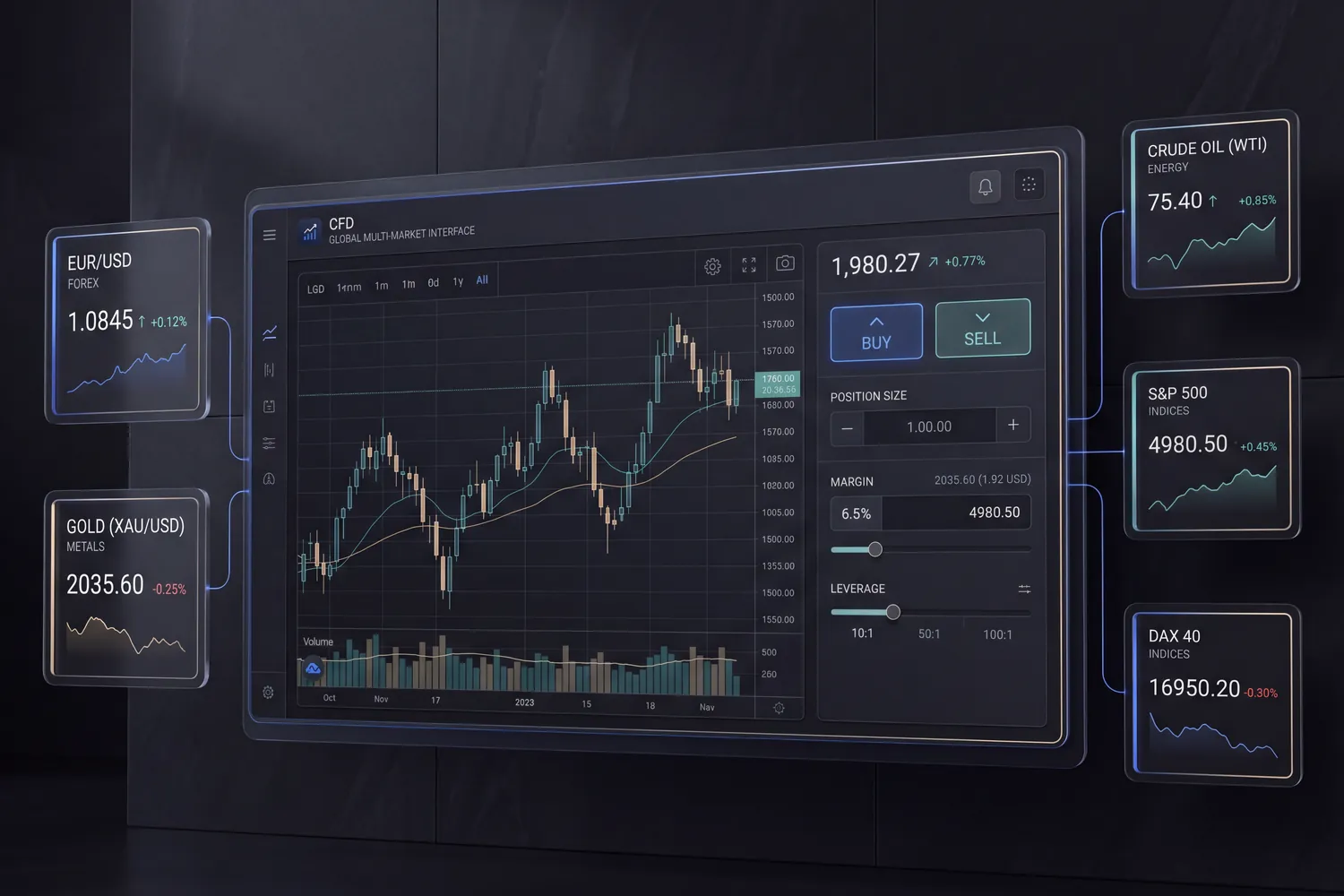
Margin requirements

The capital that has to sit behind a position for it to stay open. It is not the cost of the position, and it is not the most the position can lose.

Spread and trading costs

The difference between the price to buy and the price to sell, together with anything else charged while the position is open. A position starts behind by the spread.

Stop Loss and Take Profit orders

Instructions to close a position at a stated price. Where available they limit exposure without removing it: a market can gap straight past the level requested.

Long and short positions

Whether the position gains when the price rises or when it falls. Both carry the same kind of risk, and choosing a direction is not the same as reducing it.

Leverage

The relationship between the exposure held and the capital committed to it. It is what turns a small movement in the market into a large movement in the account.

Market volatility

How far and how fast a price moves. Volatility is not a fault in a market; it is the condition a leveraged position is held in, and it is not constant.

The part that is not optional

Leverage is why a CFD needs more attention than the market it tracks.


Margin is what a position needs in order to stay open. It is not the cost of the position, and it is not the most that the position can lose.

If a market moves far enough against an open position, the margin behind it stops being sufficient and the position can be closed without your involvement. The level at which that happens is a condition of the account rather than a level you chose.

Where stop orders are available they limit exposure without removing it. A market that gaps – over a weekend, around a scheduled release, in thin conditions – can open past the level requested, and the position then closes at the price that exists rather than at the price you set.

None of this is an argument against trading CFDs. It is the reason this site puts the product before the market: a view about where a price is going is worth very little if the instrument carrying it is not understood.

Next

Three pages that pick up where this one stops.


Account types

What distinguishes one account type from another, and the questions worth asking about the conditions attached to one.

Managing risk

Sizing a position, setting the level that closes it, and what to run through before an order rather than after it.

The trading platform

Where an order is built, the parameters attached to it, and what happens to a position once it is open.

Understand the instrument, then the process.


Everything above is a property of the contract for difference itself rather than of a particular provider, and none of it changes with the account holding it. The next question is the practical one: what opening an account involves, step by step, before any position is placed.

Trading involves risk of loss. The risk disclosure is not yet published; the standardised risk warning is shown at the foot of every page.