Running the fund costs money
Ongoing charges come out of the fund's own assets, so over time the fund tends to trail the thing it follows by roughly what it costs to run.
Exchange-Traded Funds follow an index, a sector or a market theme, so the price depends on what the fund holds and on how closely it manages to follow it.
The instrument
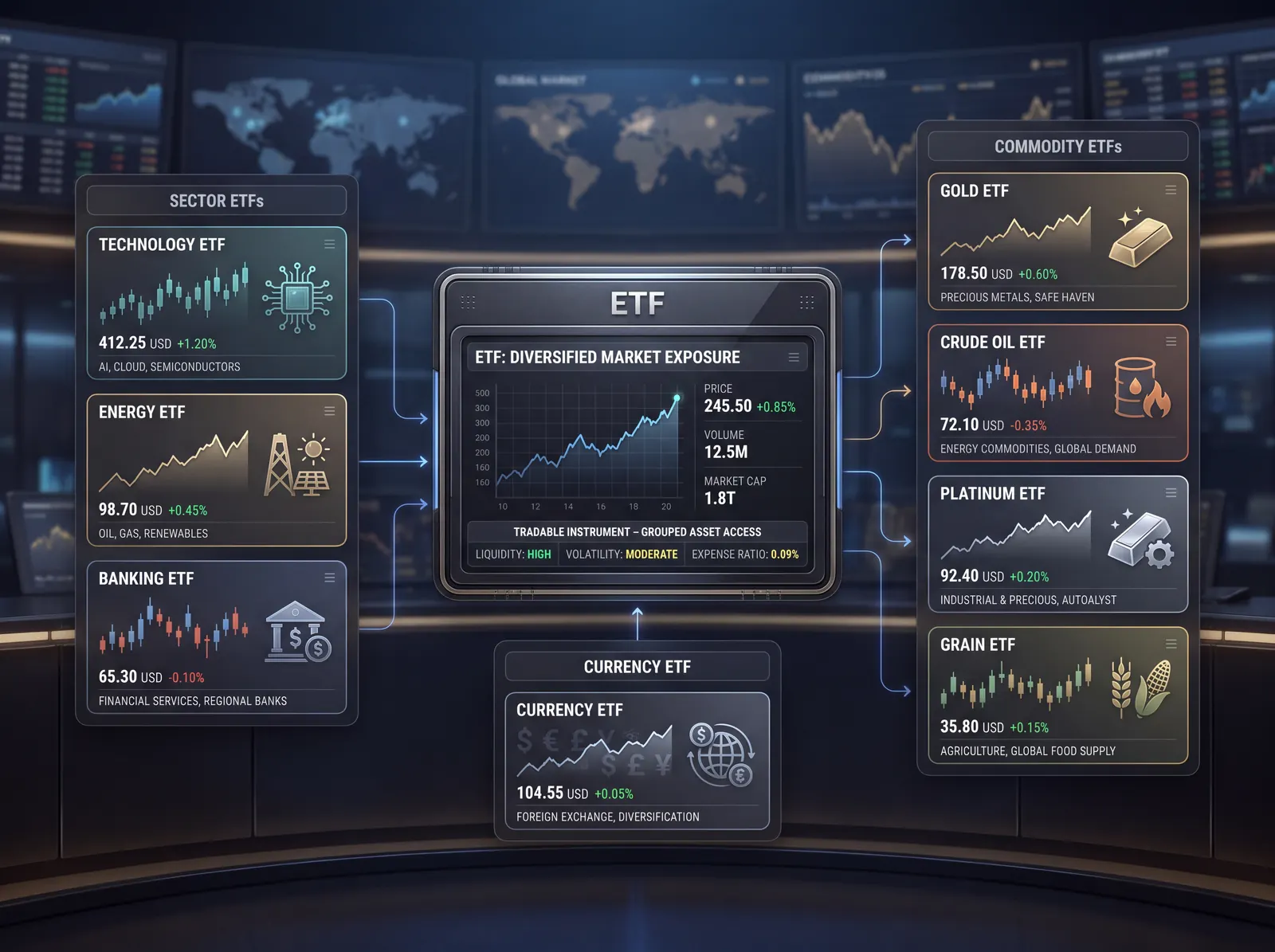
Rather than focusing on one individual company, an ETF can provide exposure to the movement of a broader group of assets.
An Exchange-Traded Fund is a pooled fund whose units trade on an exchange. It publishes what it is trying to follow — an index, a sector, a commodity market, a theme — and then holds or reproduces enough of that to follow it.
Two prices are in play from that moment on. There is the value of what the fund actually holds, and there is the price its units change hands at during the session. The two are related. They are not the same number.
An ETF instrument here is a contract for difference on the second of them: the traded price of the units. Which means the thing being tracked, the fund tracking it, and the instrument are three separate steps apart.
How tracking works
A tracking objective is a chain, and a position is taken at the far end of it. Every link can introduce a difference.
A published objective names the index, sector or market the fund is built to follow. It is a statement of what the fund is trying to do, not a promise about the result.
Some funds hold every constituent. Some hold a representative selection. Some reproduce the exposure using derivatives instead of owning anything, which brings a counterparty into the arrangement.
Units change hands on an exchange throughout the session at a price buyers and sellers agree, which can sit above or below the value of the holdings behind them.
An ETF CFD follows the units, not the index behind them. It inherits every difference introduced in the three steps above, and then adds the costs of holding the contract itself.
Where it diverges
Several ordinary features of running a fund put its price a little away from the thing it follows.
None of these are faults. They are consequences of the fund existing at all: it costs something to run, it cannot always hold everything, and it is priced by a market rather than by a calculation.
They matter because the position is taken on the fund, not on the index or the sector behind it. The gap between the two is part of the instrument, so understanding it is part of understanding what is being traded.
Ongoing charges come out of the fund's own assets, so over time the fund tends to trail the thing it follows by roughly what it costs to run.
A fund that holds a representative selection rather than every constituent will not move exactly with the full basket, in either direction.
Where a fund is priced in one currency and holds assets in another, exchange rates move its price for reasons that have nothing to do with the holdings.
Units trade at what the market will pay for them, which can sit above or below what the fund holds — and that gap tends to widen when the underlying market is closed or moving quickly.
What they are built around
The label on a fund describes its objective. What it holds, and how it holds it, is the part that decides how the price behaves.
Some funds are built around a single industry, such as technology, energy or finance, and move with that sector rather than with the wider market.
Others follow a wide index of companies, so the price reflects the group as a whole rather than the fortunes of any one constituent.
Some ETFs follow markets connected to metals, energy or other resources, and can behave quite differently from a fund holding company shares.
Different ETFs are constructed around different objectives and underlying assets, so two funds with similar names can hold very different things.
Before you trade it
Not all ETFs behave the same way.
Before trading one, understand what it tracks, how it is structured and the risks affecting its price.
Which ETF instruments are available depends on the account, and no instrument list is published on this site yet. Nothing on this page confirms that a particular fund is offered.
Keep reading
The pages next to this one cover the measure most funds are built to track, the contract the position is actually taken through, and what leverage does to it.
Many ETFs are built to follow an index. What an index actually is, and how the level is arrived at.
What the contract itself is: margin, spread, long and short, and the costs of keeping a position open.
What leverage does to a position, and the half of the decision that is not a view on the market.
Next step
Online registration is not open on this site yet. Enquiries go through the support page in the meantime.
Trading involves risk of loss. The risk disclosure is not yet published; the standardised risk warning is shown at the foot of every page.