
An index is one number standing for a whole market.

It is a calculation over a defined group of companies, so the level reflects the group rather than any single business inside it.

The instrument

What that number is actually measuring.


Instead of following one individual business, an index can reflect the combined movement of many companies within a defined market.

An index is built from a defined list of companies and a rule for how much each of them counts. Combine the constituent prices according to that rule and the result is a single number — the index level. Nothing is bought or sold to produce it; it is arithmetic performed on prices that already exist.

That makes indices useful for understanding how a broader market, economy or sector is performing as a whole.
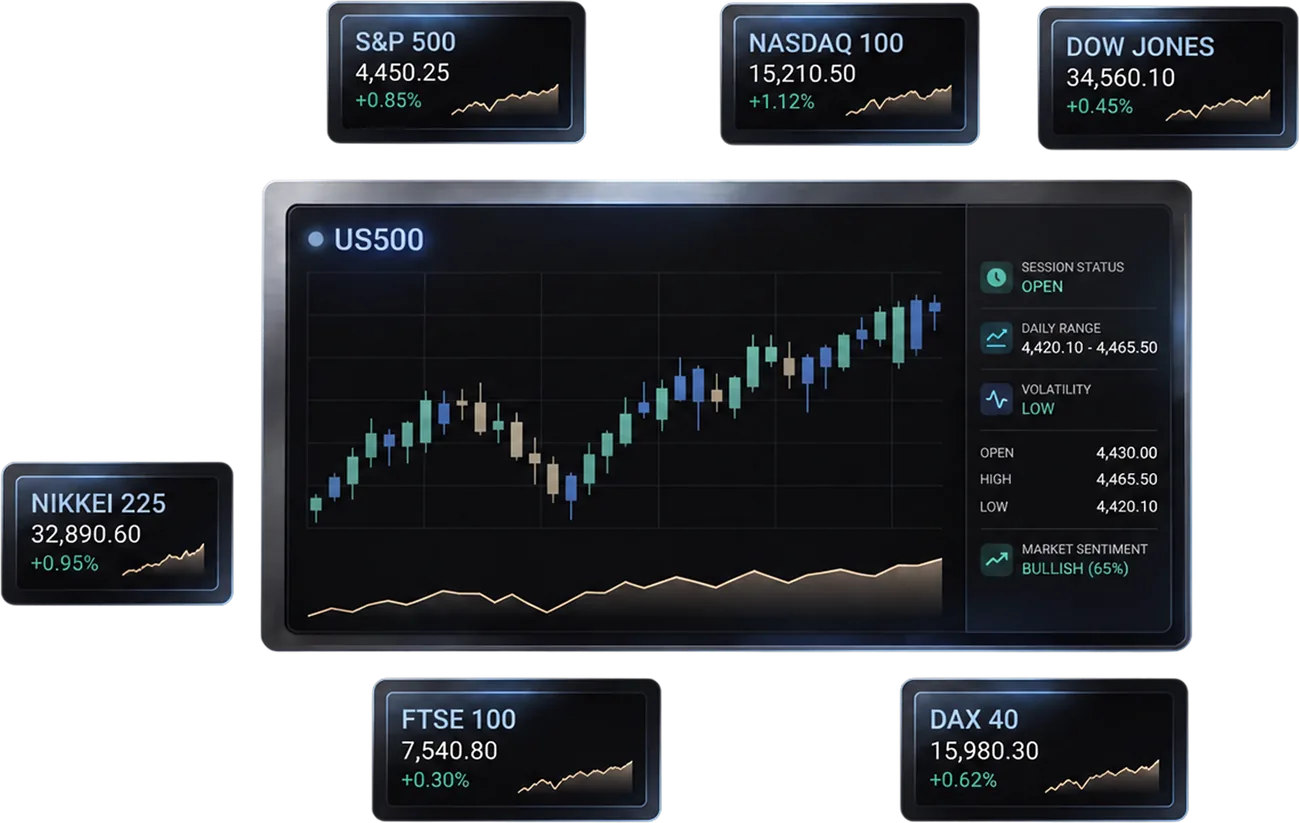
Trading an index instrument is a position on that arithmetic. There is no holding in the companies inside the index, and nothing that comes with owning their shares. What the position is exposed to is the movement of the level.

How it is built

How the level you trade is arrived at.


Four steps between a list of companies and a tradable number. Each one shapes how the finished measure behaves.

  1. A rule decides what is in it

    Every index publishes a methodology: which companies qualify, how many of them there are, and what happens when one stops meeting the criteria. The list is maintained, not fixed.

  2. A weighting decides what counts

    Constituents rarely count equally. Some indices weight by the size of the company, others by its share price, and that choice decides which names move the level most.

  3. The weighted prices become one number

    Those weighted prices are combined into the index level and published continuously while the underlying market is open. It is a measure of the group, not a price anyone pays.

  4. An instrument references that number

    An index CFD takes its price from the level. The position is on the movement of a published measure — not a stake in any of the companies the measure describes.

Against a single stock

A group does not behave like the companies inside it.


The same piece of news lands differently on an index than it does on the share it belongs to.

A single company can be revalued in a morning by its own results, its own management, its own lost contract. An index absorbs that event in proportion to how much the company counts, which is often very little.

The reverse holds too. When rates, growth expectations or sentiment reprice the whole market, constituents move together and the level can travel further than any one of them would on its own news.

Weighting decides influence

A constituent moves the level in proportion to its weight, so the largest names in an index carry most of the movement and the smallest can be almost inaudible.

Company news is diluted

One company's announcement changes the index level far less than it changes that company's own share price. The group absorbs it.

Concentration does not disappear

An index whose largest constituents share a sector still rises and falls with that sector, however many companies are counted below them.

Broad is not uncorrelated

Constituents can and do fall together. Following a group rather than one company changes the shape of the risk; it does not remove it.

What moves it

What moves an index level.


Economic expectations, monetary policy, corporate earnings and investor sentiment can all influence major indices.

Scheduled data and policy

Growth, inflation and employment releases, and the interest-rate expectations that follow them, are read across every company in the index at once.

Earnings across constituents

A results season reprices many constituents inside a few weeks, and the level reflects the pattern across them rather than any single report.

Sentiment and positioning

Broad appetite for risk moves indices directly, which is why a level can move on a day with no company news in it at all.

Maintenance of the index

Constituents are reviewed and replaced under the index's own rules, so what the level measures is not quite the same thing from one year to the next.

Before you trade it

Know what an index contains before you trade it.


Two indices covering the same country can hold different companies, weight them differently and behave differently in the same week. The name is not the instrument — the methodology is.

Index instruments also trade to a schedule. A level moves while its market is open, and prices can move between sessions, so a position can be re-priced away from where it was left.

Which index instruments are available depends on the account, and no instrument list is published on this site yet. Nothing on this page should be read as confirming that a particular index is offered.

Keep reading

An index level is only the last step of a longer chain.


The pages next to this one cover the contract the position is taken through, what leverage does to it, and the other instrument built on a basket.

Next step

Indices sit in the same trading environment as the companies inside them.


Online registration is not open on this site yet. Enquiries go through the support page in the meantime.

Enquire About an Account

Trading involves risk of loss. The risk disclosure is not yet published; the standardised risk warning is shown at the foot of every page.